
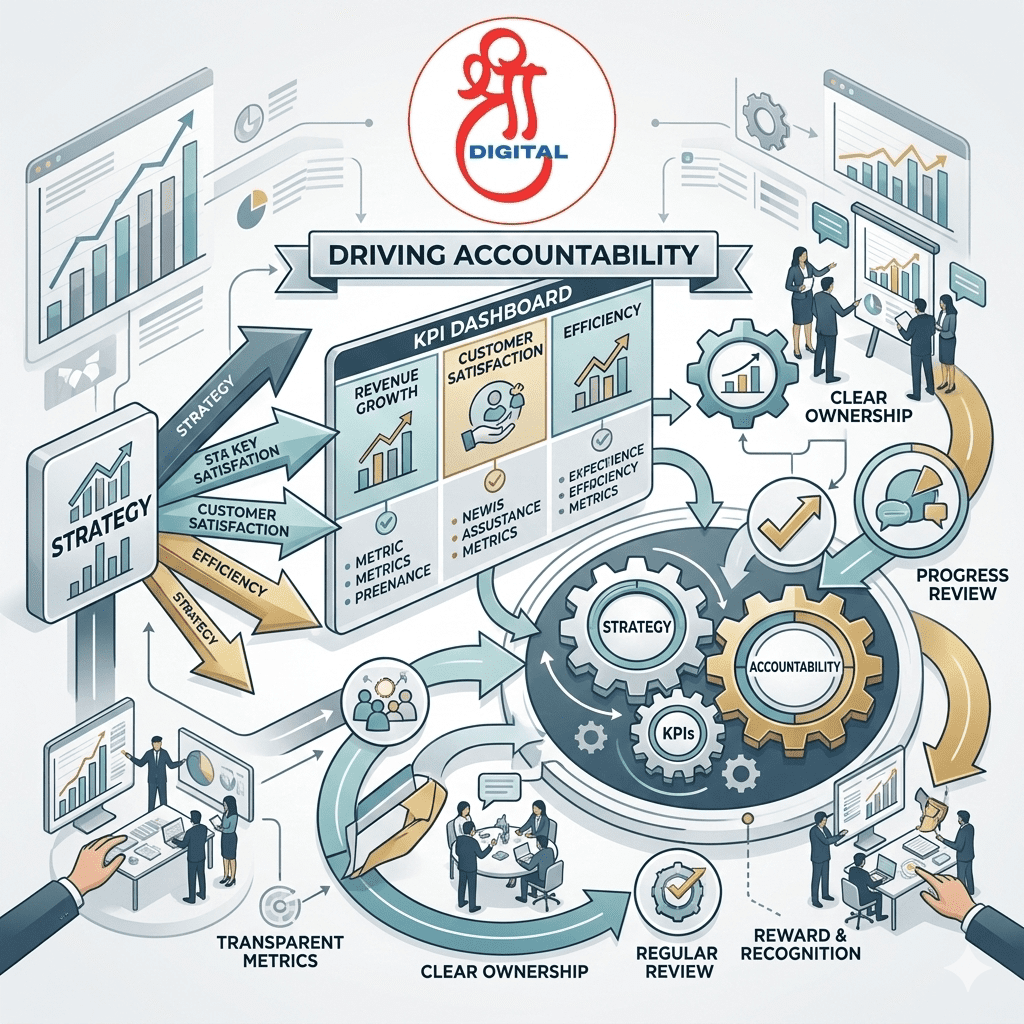
Performance Tracking With KPIs In every successful organization, accountability plays a key role. Teams need to understand what they are responsible for and how their work supports the company’s goals. However, accountability does not happen automatically. It develops through clear planning, measurable goals, and strong alignment between strategy and daily activities. This is where Key Performance Indicators (KPIs) become very important.
When companies connect KPIs with their overall strategy, employees clearly understand what matters most. As a result, teams work with more focus, leaders track performance easily, and organizations achieve better results.
–> Boost your online growth with Shri Digital, your trusted partner for performance-driven marketing and complete eCommerce solutions
Why Accountability Matters in Organizations
First, accountability builds trust within teams. When employees know their responsibilities, they are more likely to take ownership of their work. At the same time, managers can monitor progress and provide guidance when needed.
Without accountability, teams often feel confused about priorities. For example, employees may stay busy with tasks that do not support the main business goals. As a result, productivity decreases and valuable resources are wasted.
On the other hand, when accountability is clear, everyone understands what success looks like. This clarity helps employees stay motivated and focused. Therefore, organizations become more efficient and productive.
Understanding KPIs
Key Performance Indicators, commonly known as KPIs, are measurable values that show how effectively a company is achieving its objectives. In simple words, KPIs help businesses track progress and measure success.
For example, a sales team may track revenue growth, number of new clients, or customer retention rate. Similarly, a marketing team may measure website traffic, lead conversions, or campaign performance.
Businesses that provide Affordable Digital Marketing Services in Meerut often rely on KPIs to evaluate marketing campaigns and ensure that clients receive measurable results. Because KPIs provide clear data, companies can easily identify areas that need improvement.
The Importance of Strategy Alignment
Although KPIs are useful, they only work well when they are connected to the company’s strategy. Strategy defines the long-term direction of a business. Therefore, KPIs should support the most important strategic goals.
For instance, if a company focuses on online visibility, its KPIs may include search rankings, website traffic, and conversion rates. This approach is often followed by agencies offering Best SEO services in Meerut, where success is measured through improved search engine performance and organic traffic growth.
Similarly, a Best SEO Expert in Meerut may track keyword rankings, backlink quality, and page performance to ensure that SEO strategies align with business goals.
When KPIs match the strategy, every department works toward the same objective. Consequently, the entire organization moves forward together.
How Clear KPIs Drive Accountability
1. They Define Expectations
First, KPIs clearly explain what employees should achieve. Instead of vague instructions, teams receive specific targets. This clarity helps employees focus on meaningful tasks.
2. They Measure Progress
Second, KPIs help organizations track performance over time. Leaders can analyze data and identify what works well and what needs improvement.
Companies that offer Lead Generation Services in Meerut, for example, often track metrics such as qualified leads, cost per lead, and conversion rate to measure campaign success.
3. They Encourage Ownership
Third, when employees know their performance is measured, they feel responsible for their results. This sense of ownership motivates teams to improve their work and achieve targets.
4. They Support Fair Evaluation
Finally, KPIs make performance evaluation more objective. Managers can review measurable results instead of relying on opinions. As a result, employees feel that the system is fair and transparent.
Steps to Align KPIs With Strategy
Start With Clear Strategic Goals
First, leaders must define clear business goals. These goals may include expanding market reach, improving customer satisfaction, or increasing revenue through Online Marketing Services in Meerut.
Without a clear strategy, it becomes difficult to create meaningful KPIs.
Translate Strategy Into Team Objectives
Next, organizations should convert company goals into team-level objectives. Each department should understand how its work supports the larger mission.
For example, a Best Digital Marketing Agency in Meerut may divide goals among SEO teams, content teams, and paid advertising specialists to ensure that each team contributes to growth.
Choose the Right KPIs
After that, companies should select KPIs that truly measure success. Good KPIs are simple, measurable, and directly connected to the strategy.
Too many KPIs can create confusion. Therefore, businesses should focus on the most important metrics.
Review and Improve Regularly Performance Tracking With KPIs
Finally, KPIs should be reviewed regularly. Business environments change quickly, especially in digital industries.
For instance, a Google Ads Expert in Meerut may adjust campaign KPIs based on changing advertising trends, audience behavior, or budget strategies. Regular evaluation ensures that performance metrics remain relevant.
Building a Culture of Accountability
KPIs and strategy alignment work best in a supportive workplace culture. Leaders should encourage open communication, collaboration, and continuous improvement.
When teams miss their targets, the focus should be on learning and improvement rather than blame. By analyzing problems and finding solutions together, organizations can strengthen their performance.
In addition, recognizing employees who achieve their KPIs can increase motivation. Small rewards, appreciation, and feedback help build a positive work environment.
Conclusion
Driving accountability in an organization requires clear goals, measurable KPIs, and strong alignment with business strategy.
When employees understand their responsibilities and see how their work contributes to larger objectives, they perform with greater focus and confidence. At the same time, leaders gain valuable insights through performance data.
Many businesses today, including those providing digital marketing solutions such as SEO, paid advertising, and lead generation, rely on this structured approach to achieve measurable growth.
Therefore, organizations that align strategy with well-defined KPIs create a strong foundation for accountability, improved performance, and long-term success.